Minneapolis Trash Ash Ends Up in Rosemount
TLDR
Minneapolis runs a big trash incinerator called the HERC. Burning trash leaves behind ash — and most of that ash gets trucked to a landfill in eastern Rosemount.
An environmental group just sent Hennepin County a legal demand letter saying the county isn't following state law on how it handles that ash. The county has 10 days to respond.
The ash has heavy metals and "forever chemicals" (PFAS) in it. The Rosemount landfill says it's lined and added a PFAS treatment system in 2024 to pull PFAS out of the leachate — the contaminated liquid its liner system captures, not Rosemount's groundwater.
Here's the catch for us: this is mostly a Hennepin County decision. Rosemount sits downstream, but doesn't get a direct vote.
It plugs right into the bigger "how much industrial stuff can one city take" debate that's been driving Rosemount's data center fight.
So here's the deal. There's a story bouncing around the news right now about a Minneapolis trash incinerator. Sounds like a Minneapolis problem, right? It's not — at least not entirely. The ash from that incinerator ends up here, in Rosemount. And this week it turned into a legal fight. Let's break it down.
So what's actually getting buried here?
Minneapolis has a facility downtown called the Hennepin Energy Recovery Center — everyone just calls it the HERC. It burns garbage and turns it into energy. It burns a LOT of garbage: close to 365,000 tons a year.
When you burn trash, you don't make it disappear. You shrink it. What's left over is ash — and roughly 20% of what goes in comes back out as ash. The environmental group pushing on this says that's about 80,000 tons of ash a year. That's their number, but the math is in the ballpark.
Since 2004, that ash has been trucked down to the SKB landfill in eastern Rosemount, out by the Pine Bend industrial area. A company even mines the ash for leftover metal — gold, copper, steel — before the rest gets buried. The concern is what's in the part that stays: lead, cadmium, mercury, and PFAS "forever chemicals." Those are genuinely nasty substances, linked over long-term exposure to things like cancer and nervous-system harm.
The landfill says it's built exactly for this
This is the part the headlines tend to skip, so it's worth saying plainly.
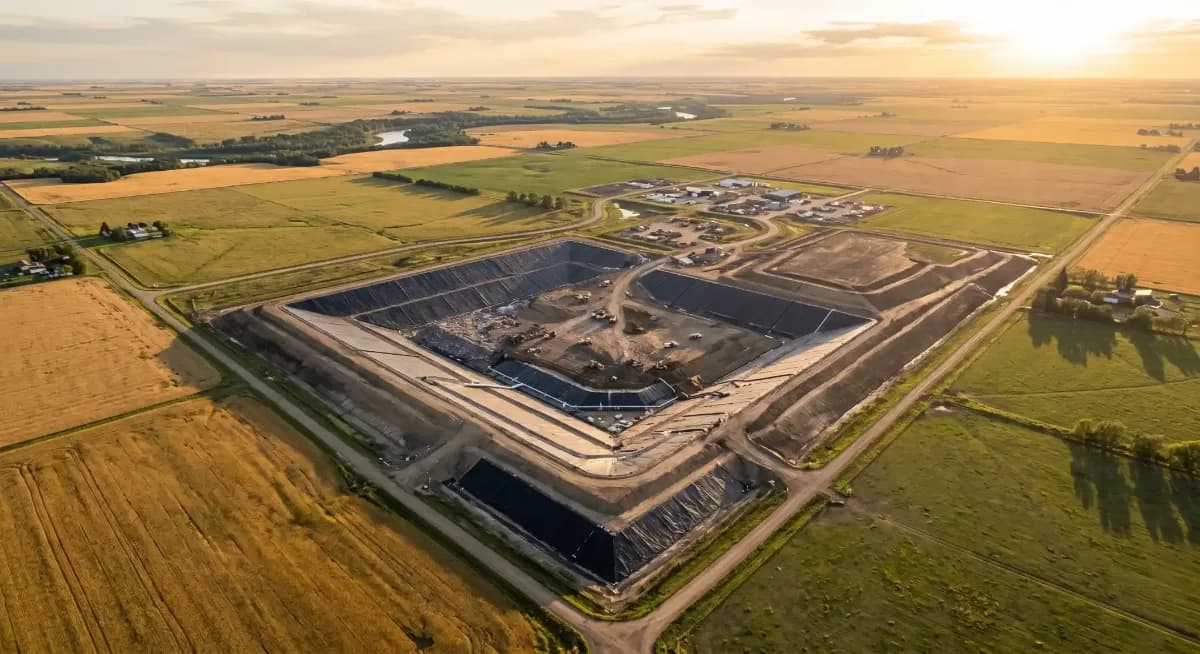
The SKB Rosemount site isn't a hole in the ground. It's a lined landfill — think of it like building a giant bathtub out of clay, soil, and plastic liners, with a double system for catching the liquid that drains through (that runoff is called "leachate"). They run an on-site lab, and the company says it's never gotten a violation in its history.
In 2024, SKB also installed a full-scale system to pull PFAS out of that leachate — which it bills as the first of its kind in Minnesota and the country. You can read about the facility on SKB's own page for the Rosemount site.
Now the flip side: the reason that PFAS system exists is that PFAS was showing up in the landfill's leachate — the liquid the liner system is built to capture before it can reach groundwater. So both things are true at once — the site has serious containment, and the chemicals it's containing are the kind nobody wants near groundwater. That tension is basically the whole argument.
Why it's suddenly in the news
On June 10, the Minnesota Center for Environmental Advocacy — part of a coalition trying to shut the HERC down — sent Hennepin County a legal demand letter. Their argument: state law (Minnesota Statute 115A.97) requires the county to lay out, in its official waste plan, how it'll reduce the toxicity and amount of that ash. They say the county's current 2024–2029 plan doesn't even mention incinerator ash. The county now has 10 days to respond before the group says it'll take legal action.
The letter also points to a county facility assessment, obtained through a records request, that the group says described the HERC's ash-handling equipment as "ash encrusted, badly corroded, and physically damaged." We haven't seen that document ourselves, so treat that as the group's characterization for now.
A few of the scarier figures floating around deserve the same caution. The claim that the HERC causes "1 to 2 premature deaths a year" comes from an independent estimate using an EPA modeling tool — and the county's own risk analysis uses a different method that critics say leaves out a key pollutant. In other words, the two sides are measuring different things and landing in different places. And a Macalester statistics professor speaking for the coalition went as far as calling Rosemount a "sacrifice zone," pointing to refineries, pollution cleanup sites, and data center proposals stacking up in the same part of town. That's a strong framing — and it's an advocacy framing, not a neutral finding.
The real fight is over the incinerator itself
The ash question is downstream of a much bigger one: does the HERC stay open at all?
Back in October 2023, the Hennepin County Board told staff to build a plan to close the HERC sometime between 2028 and 2040. In November 2024, the City of Minneapolis went further and called for it to stop burning by the end of 2027. The county and city haven't fully agreed on the timeline or who's responsible for what — the county has noted the city's faster plan doesn't say where all that trash would go instead. County Board Chair Irene Fernando has floated a phased wind-down, and you can read the county's side in her public FAQ on the HERC. For the closure-timeline backstory, KSTP has a clear rundown.
Bottom line on that fight: everybody officially agrees the HERC should close eventually. Nobody's locked in exactly when.
What this means if you live in Rosemount
First, the honest part: this is a Hennepin County facility making Hennepin County decisions. Rosemount and Dakota County residents don't get a direct vote on whether the HERC burns or when. We're the place the ash lands, not the place it's decided.
But "downstream" is exactly why people here are paying attention. The landfill sits in our city, near farming and residential areas, and the worry is about what reaches the groundwater over time. It's the same nerve that's already raw around here — Rosemount's been wrestling with water quality on its own wells, like the gross-alpha radiation issue at Well 8, and PFAS has driven real costs for neighbors like Hastings, where a PFAS cleanup is pushing water rates up.
It also feeds the bigger "how much can one city absorb" conversation. That's the same logic that's been front and center in Rosemount's one-year data center moratorium — residents asking how many heavy industrial uses get pointed at the same corner of the map.
The Bottom Line
This is a Minneapolis-area political fight with a Rosemount address attached. The legal clock is real — the county has 10 days from June 10 to respond before the coalition says it'll go to court. If the HERC eventually winds down, the truckloads of ash heading to Rosemount slow down with it. If it stays open, they keep coming.
Watch two things: whether Hennepin County answers the demand letter, and whether the data-center and industrial-load debate in Rosemount starts folding the landfill into the conversation. We'll keep an eye on both.
FAQ
Wait, why does Minneapolis's trash ash end up in Rosemount? Minneapolis burns its garbage at the HERC, and the leftover ash has to go somewhere. Since 2004, it's been trucked to the SKB landfill in eastern Rosemount, which is permitted to take incinerator ash.
Is the stuff in the landfill actually dangerous to me? The ash contains heavy metals and PFAS, which are harmful with long-term exposure. The landfill is lined and treats its drainage to keep those contained. The fight is over whether that's enough and whether the county is doing what the law requires.
Should I be worried about my water? There's no finding that Rosemount drinking water has been contaminated by the landfill. The concern raised by the coalition is about long-term risk to groundwater near the site. PFAS has shown up in the landfill's leachate, which is why SKB built a treatment system in 2024.
Can Rosemount or Dakota County just stop this? Not directly. The HERC and the decision to burn trash belong to Hennepin County. Rosemount is where the ash gets disposed, but it doesn't control whether the incinerator runs.
What happens in the next 10 days? The environmental group gave Hennepin County until roughly June 20 to respond to its demand. If the county doesn't address the ash in its waste plan, the group says it'll take legal action. Either way, the HERC's longer-term closure timeline is still being argued separately.