Lakeville's 5-Year Project Plan: Here's What's Coming to Your Roads, Parks and Water
TLDR
Lakeville's draft 2027 to 2031 plan counts on $138.8 million in bonds, and $88,105,260 of it lands in 2027.
The big three for 2027: a $35 million second water treatment plant, a $26 million maintenance facility expansion and a $20 million Fire Station 3 rebuild.
Only the maintenance facility hits your property tax levy. The other two get paid back other ways.
The debt levy still goes up 30% in 2028, then dips in 2030 and 2031.
Staff says the city's AAA bond rating is not at risk. The city council votes Oct. 5.
If you've ever wondered when Lakeville is going to fix that road, this is the document with the answer. The city's 2027 to 2031 Capital Improvement Plan is the five-year to-do list for roads, parks, water and buildings. The city council got its first full look on Sept. 8. The planning commission reviewed it Sept. 17. The council votes on it Oct. 5.
When finance director Stahl brought up the money slide at the council work session, she opened with a warning: "Don't freak out."
She meant the $88 million.
What the Planning Commission Did
Let's clear one thing up. The planning commission didn't approve any spending. State law (Minn. Stat. 462.356) says they only check that the projects match the city's comprehensive plan, which is the long-range plan for how Lakeville grows.
City engineer Zach Johnson said staff checked every project and found no conflicts. Commissioner Swanson moved to recommend it, and the vote was 6–0. The money decisions belong to the city council.
What the $88 Million Buys in 2027
Fire Station 3, $20 million. This is not the new station going up on Dodd Boulevard. That's the consolidated Station 2 at 17624 Dodd. Station 3 is the 5,341-square-foot station built in 1988 at 17490 Kenrick Avenue, just south of Fleet Farm. The city studied fixing it up and decided a full rebuild costs less in the long run. The council hired Leo A. Daly to design it for $996,875, paid out of franchise fees. Design work kicked off the morning of the planning commission meeting.
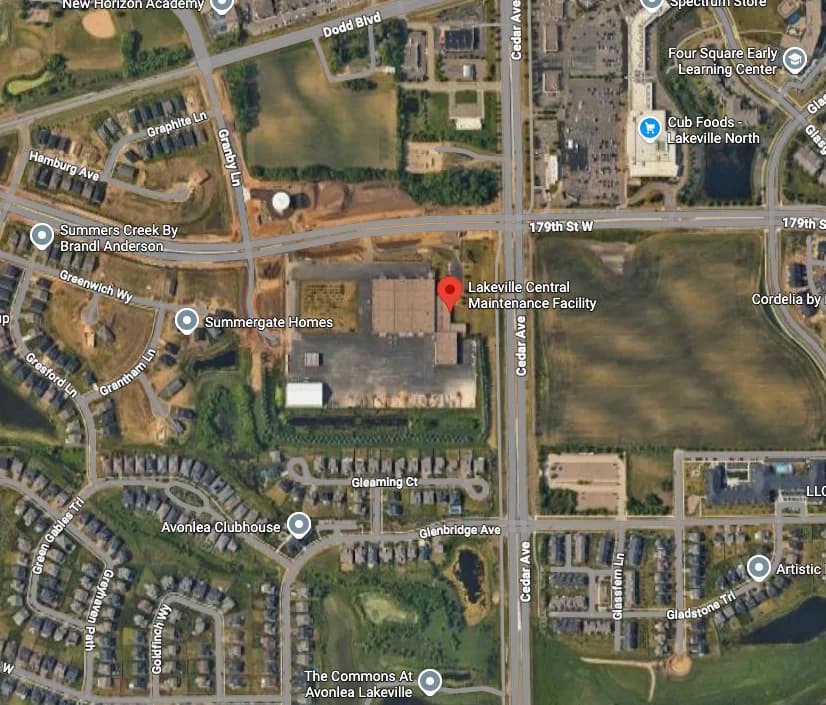
Central maintenance facility expansion, $26 million. This is where the city keeps its plows, mowers and fleet equipment, and it has outgrown the space. "We are really packed in there right now," Stahl said. This is also the one project that lands on your property tax levy.
A second water treatment plant, $35 million in bonds. It goes at the northeast corner of 179th Street and Granby Lane, and the full project runs about $40 million. A 2026 study said the city needs it. Johnson explained how the system works: wells pull water from underground, pipes carry it to a treatment plant, the water gets cleaned to Department of Health standards, then it goes back out to your tap. The city looked at just making the current plant bigger. It chose a second plant instead so that a main break or a problem at one plant doesn't take the whole system down. It should be done by the end of 2027.
Does the city soften the water? Johnson said he wasn't sure and would find out.
Street reconstruction and collector roads, about $7.1 million. That's the normal annual amount the city bonds.
Who Actually Pays
This is the part that gets lost. The three big 2027 projects get paid back three different ways.
Fire Station 3 gets repaid with franchise fees, the charge already built into your utility bills.
The water plant gets repaid through your water and sewer rates. The city is also moving $9 million out of the water operating fund so it doesn't have to borrow the whole cost.
The maintenance facility is the one that rides on the property tax levy.
Here's the number to watch anyway. The debt levy, the part of your property tax that pays off city bonds, goes up 30% in 2028, from $12,297,737 to $15,971,848. It dips again in 2030 and 2031 as older bonds get paid off. That's one part of your tax bill, not the whole thing.
Coming to Your Roads
Roads are the biggest chunk of the plan. Every year the city runs three programs: pavement management, local street rehab and collector street rehab. We explained how streets get picked in our pavement management breakdown.
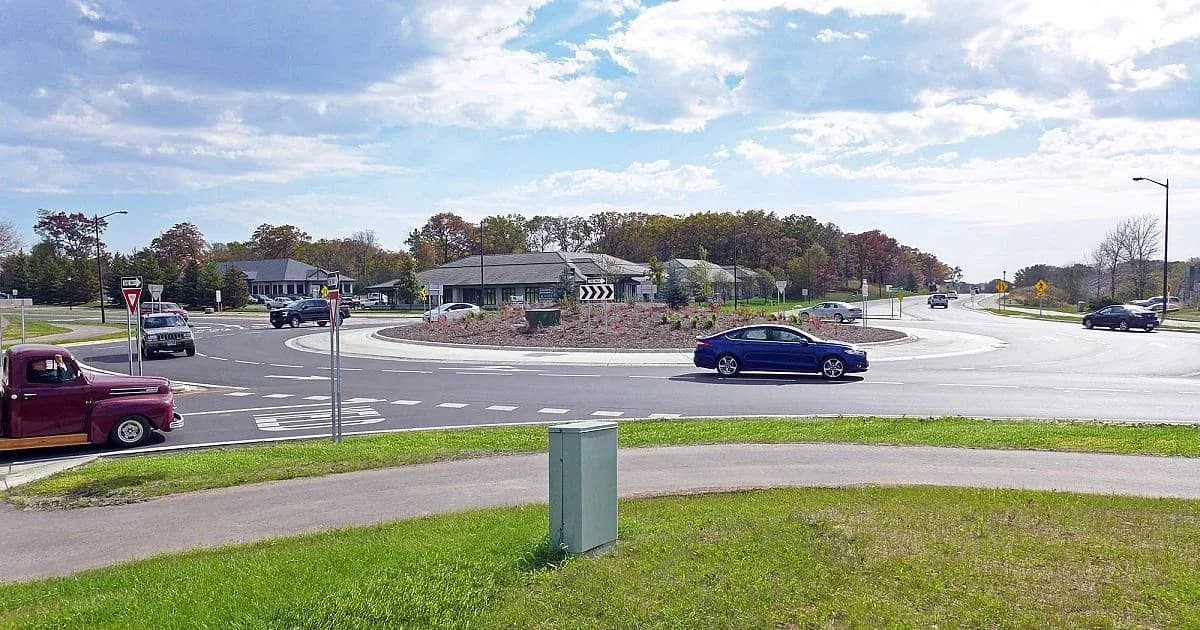
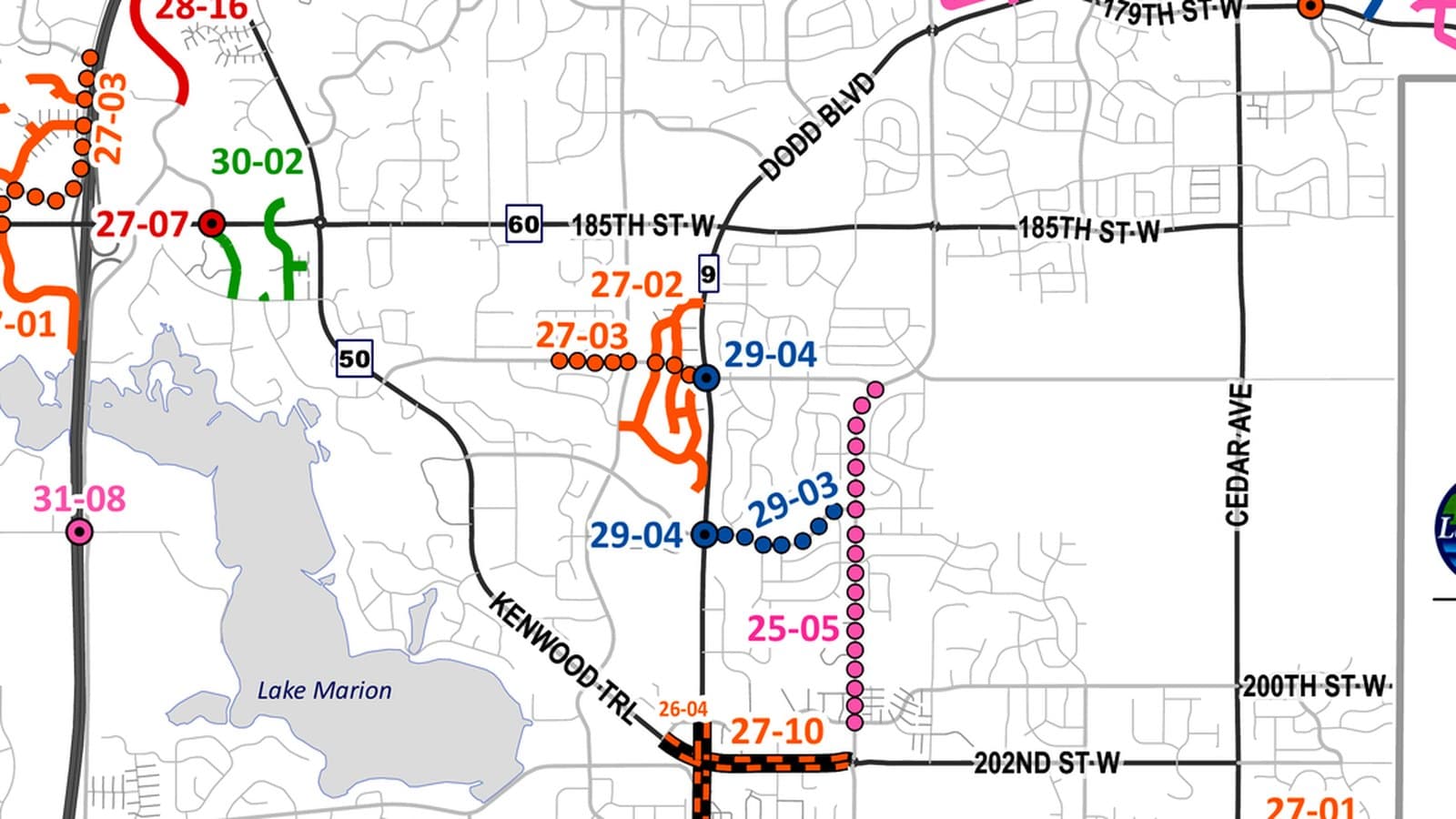
2027: the Dodd Boulevard rebuild from 210th to 202nd Street, new signals at Kenyon Avenue and at Dodd and Glacier Way, a Cedar Avenue mill and overlay run by Dakota County, and the freight rail car storage yard that finally moves rail car storage out of the area west of Dodd. The Kenyon signal is listed for 2027, but the city hopes it's running by Dec. 1 of this year.
2028: Dodd from 215th to 210th, and Kenrick Avenue extended from 181st to 176th Street.
2029 and 2030: the I-35 and County Road 50 interchange, plus Dodd fixes at 194th and 190th.
2030: County Road 50 and Lakeville Boulevard widened east of Cedar toward Farmington.
Johnson said the timing is on purpose. The city wants those new signals in before the interchange work starts. You can track active work on the city's construction projects page.
Parks, Wells and Buildings
The 2027 park list includes the Lake Marion Greenway, East Community Park phase 2 and Voyageur Park. In 2028 the Klamath Trail retaining wall gets fixed, the Bunker Hill athletic decks get redone and Ritter Meadows Park gets built. Later years add a park at Keokuk Avenue and 172nd Street, a skatepark and a park at 210th Street and I-35. That lines up with what 1,300 residents told the city they wanted.
Two new wells, 24 and 25, come in 2028. The Fairfield water tower gets repainted in 2030. Fire Station 1 gets a $20.5 million renovation in 2028, and the police station gets a workout room expansion in 2029.
Does This Hurt the AAA Rating?
A council member asked it straight: does borrowing this much put the city's triple-A bond rating at risk? Stahl said no.
None of it is a surprise. The maintenance facility has been in the long-range plan for years, and the city works with financial advisors to spread the hit out. Old debt is also falling off fast, roughly $16 million a year for the next four years, so some of the new borrowing backfills a hole that was opening anyway.
There was one twist. A bigger bond sale is actually easier to sell. Lakeville usually issues $20 to $30 million and gets 13 or 14 bids. An $88 million sale pulls in a wider pool of buyers.
The Bottom Line
This plan shows where Lakeville is spending on growth and upkeep through 2031. "It's the things that nobody thinks about till it doesn't work," Commissioner Swanson said.
The city council votes Oct. 5, and that's where you can speak up. Dakota County releases its own capital plan in October and has asked Lakeville for a resolution of support in November.