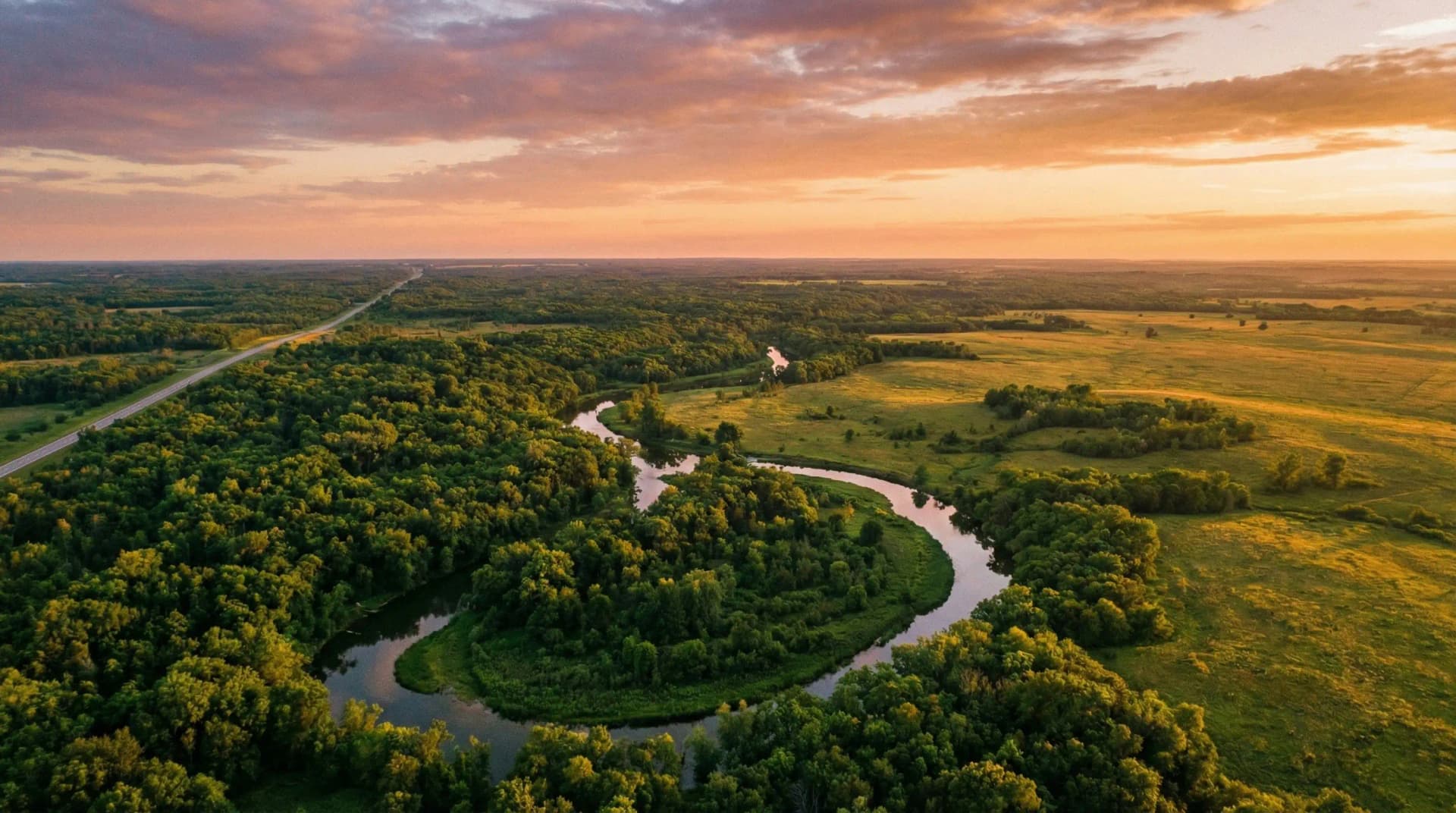
Carpenter Nature Center Almost Had a Highway Running Through the Middle of It
Here's a piece of local history most people don't know: in the 1980s, there was a serious proposal to straighten out Highway 10 and relocate the Prescott Bridge about a mile upstream. If that plan had gone through, the new highway would have cut directly through what is now Carpenter Nature Center.
The nature center's first director, Jim Fitzpatrick, spent years fighting it off. And he won. Then he had to do it again — this time against a plan to put a new international airport in Dakota County.
We heard both stories recently from Mayme Johnson, who spent over 30 years at Carpenter. She covered them in a 45th anniversary presentation for the nature center that Hastings Community Television put on YouTube. Here's the short version.
What Was Being Proposed With Highway 10
The curve on Highway 10 where it dips down toward the Prescott Bridge is a well-known stretch for South Metro drivers. The proposal was to eliminate that curve — to bring Highway 10 straight across from Prescott into Minnesota rather than following the bluff line. The problem? That straight shot would have run right through the Carpenter property along the St. Croix River.
Mayme put it simply in her talk: Jim had to deal with that for a couple of years. He finally convinced them to keep it where it was.
MnDOT ultimately rebuilt and widened Highway 10 in 2000, but it stayed on its original route. The Prescott Bridge stayed put too. Carpenter Nature Center is still there, intact, because someone pushed back hard enough and long enough to make the case that the land was worth protecting.
The Airport That Would Have Swallowed Dakota County
The highway wasn't the only time outside forces threatened the land around Carpenter Nature Center.
In the early 1990s, there was a serious proposal to relocate Minneapolis-St. Paul International Airport to Dakota County — on a site southwest of Hastings. The Metropolitan Airports Commission selected that site in 1994, and the proposed footprint was enormous — nearly 10,000 acres. That's 100 square miles of farmland, homes, and open space that would have been paved over.
Dakota County residents were not happy. More than 100 people showed up to a public hearing to oppose it, including many from Hastings. The MAC board ultimately voted 11-3 in 1996 to recommend expanding the existing MSP instead of building a new airport.
Jim Fitzpatrick spent years working against that proposal too, including bringing a barn owl from the nature center to public presentations under a campaign called SOAR — Stop Our Airport Relocation. Mayme explained the reasoning in her talk: one of the farms inside that 10,000-acre footprint was the northernmost nesting site for barn owls at the time. It was a concrete, local, wildlife-centered argument against a massive infrastructure project. The kind of detail that makes an abstract policy fight real.
The airport never moved. The land in Dakota County was spared.
This kind of civic fight is what keeps South Metro communities looking the way they do. It's worth remembering as Hastings faces its own big development decisions today — including a 1,500-unit housing gap and new projects pushing into the northern edges of the city.
Why This Matters Now
These aren't just old stories. They're reminders that public land doesn't protect itself. Carpenter Nature Center exists in the form it does today because people showed up, made arguments, and stayed in the fight long enough to change outcomes.
The same dynamics play out in city council meetings across the South Metro every month — decisions about land use, infrastructure, and development that most residents never hear about until it's too late to weigh in.
The Bottom Line
Carpenter Nature Center is at 12805 St. Croix Trail in Hastings. Free admission, three miles of paved trail, an apple orchard, and a river view that's hard to beat in the South Metro.
Worth seeing what almost wasn't there.
Advertisement